Lumber Inc
- 4.4
- Rating
- 1.00M
- Installs
- Free
- Price

 Analysis by App-foxy
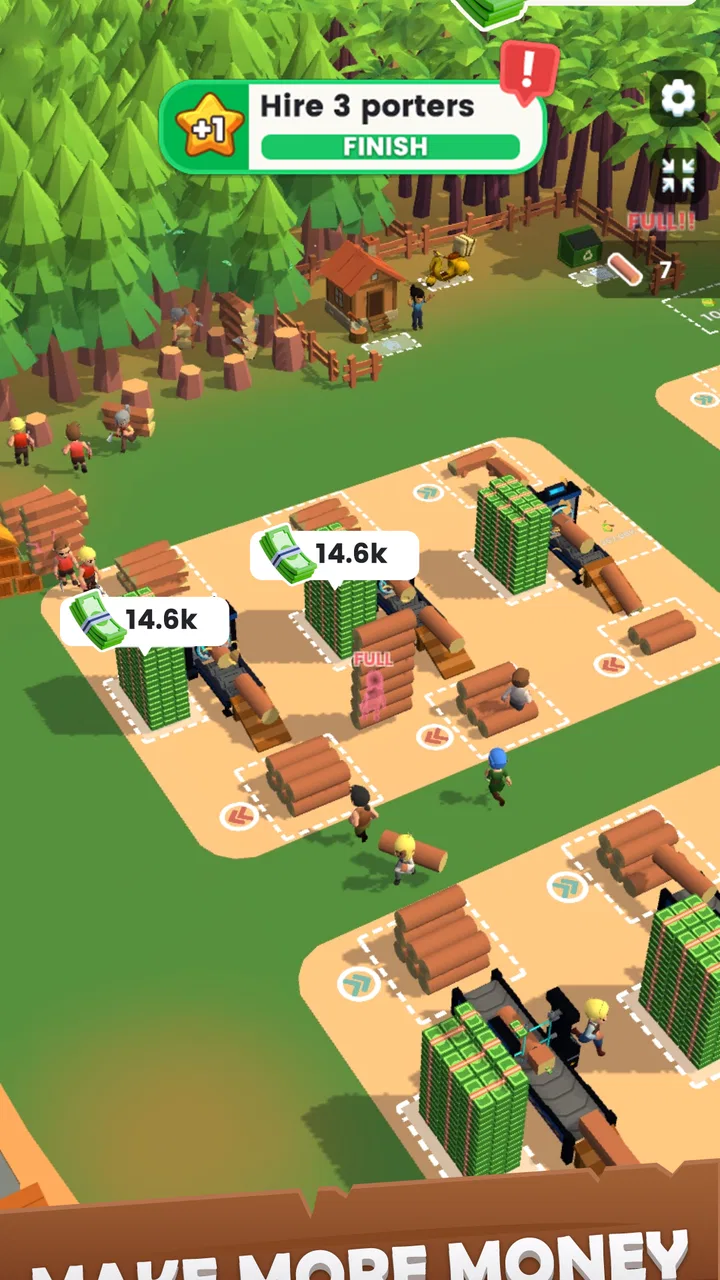
I went into Lumber Inc expecting a simple idle logging game, and that is exactly where its first appeal comes from. You chop trees, turn timber into useful materials, improve the operation, and gradually move toward a forest business that can keep working with less constant attention. The idea is easy to understand within minutes, but the better question is whether that loop remains satisfying once the novelty wears off.
My short answer is that it can, especially if you enjoy watching a small production chain become more efficient over time. This is a free simulation game from Clingycat Games, rated for Everyone, with a 4.4 average from around 5,400 ratings and more than 100,000 installs. Those figures suggest that the game has found an audience, but they do not remove the need to look closely at its rhythm. Idle games live or die by how rewarding their routine feels after the first few sessions.
What the first week feels like
The opening hours are built around clear, visible progress. You begin with a modest lumber operation and gradually make it more capable. The attraction is not just tapping for resources; it is seeing separate parts of the business support one another. Cutting, processing, crafting, and automation feel more meaningful when an upgrade changes the way the whole operation behaves rather than simply adding another decoration.
You May Also Like

 Blood Strike: 2.5 Anniversary
Blood Strike’s Loadouts Turn Every Drop Into a Tactical Gamble
A close look at Blood Strike’s custom loadouts: how fast access to signature weapons reshapes its battle royale rhythm, rewards preparation, and narrows the gap between fights.

 Pandora - Music & Podcasts
Pandora’s Music Is Easy to Start, but Harder to Recover
Pandora’s strength is its low-effort path from a seed to a station. Its weak spot is how much confidence it asks you to place in connection, setup, and quiet recovery.

 8 Ball Pool
 Is Built on Rivalries, Rematches, and Routine
A close look at the rivalries, rematches, shared routines, and unanswered safety questions that turn a quick pool match into a persistent mobile community.

 Samsung Music
’s Quiet Strength Is Playing What You Already Own
Its reach comes less from spectacle than from dependable access to a personal library. That simplicity is both the app’s strongest retention engine and its ceiling.

 AccuWeather: Weather Radar
AccuWeather Review: A Quick, Clear Forecast for Everyday Decisions
For everyday plans, the best forecast is the one you can understand quickly. AccuWeather makes rain timing, radar, and local conditions easy to act on, with a few trade-offs.

 Hill Climb Racing
Why Hill Climb Racing Still Turns Crashes Into One More Run
A tiny car, a bumpy hill and one more upgrade: Hill Climb Racing keeps resurfacing because its simple chaos makes every near-miss feel personal.
More From Our News Desk
View All News


I found the early game particularly approachable because it does not demand that I understand every decision immediately. I could make a few improvements, collect what the business generated, and then decide where the next investment would have the greatest effect. That makes it suitable for short sessions. A few minutes while waiting for a bus or taking a break can be enough to make progress without requiring a long uninterrupted play session.
The first useful habit is to avoid spending every resource as soon as it becomes available. It is tempting to upgrade whichever option is highlighted, but a production chain works better when its slowest part receives attention. If processing falls behind cutting, increasing raw material output may only create a larger queue. I got more value by watching where work accumulated and improving that point first. This is a small lesson, but it gives the game more thought than a basic button-tapping experience.
Automation is also more interesting when treated as a planning tool rather than a reward to collect and forget. The aim is not merely to make the business run while I am away. It is to arrange improvements so that returning later feels productive instead of revealing that one neglected stage has held everything back. Players who enjoy optimizing a chain will notice this quickly; players who want direct control over every action may find the hands-off direction less engaging.
There is a pleasant sense of scale during the first week. A small decision can feel important because the operation is still compact. Upgrading one area changes what I can afford next, and that creates a natural sequence of goals. The game does not need a complicated story to provide motivation. Its immediate reward is the growing sense that the lumber business is becoming less dependent on my constant input.
That simplicity is also the first limitation. The early loop can feel repetitive if you need frequent surprises, detailed character interaction, or a strong narrative. This is a management toy built around production and improvement, not a deep forestry simulator. It is best approached as a relaxing progression game rather than a realistic business model.
How to play without turning every session into chores
My most useful early routine was to check the operation in a fixed order. I looked at what was being produced, identified the stage that was slowing everything down, collected available rewards, and only then chose an upgrade. This prevented me from making impulsive purchases based on whichever option happened to look most attractive. It also made short visits feel purposeful.
Another practical approach is to decide whether a session is for active progress or simple maintenance. During an active session, I focused on improvements and watched how the chain responded. During a maintenance visit, I collected output, corrected obvious bottlenecks, and left. Separating those two moods helps because the game is not equally exciting every time it is opened.
For a realistic everyday example, I can imagine playing before work, checking the operation again during lunch, and returning in the evening to spend the accumulated resources. That pattern suits the game better than trying to remain glued to it. The idle structure is most comfortable when it complements a day rather than competing with it.
Does the loop hold up from month to month?
The monthly question is more demanding. Early upgrades arrive frequently enough to create momentum, but long-term value depends on whether the player enjoys the process of making small improvements after the obvious discoveries are gone. In my experience, the game’s lasting appeal comes from optimization and routine, not from constant novelty.
There is satisfaction in returning to a setup that once felt inefficient and gradually making it smoother. A better-balanced operation reduces the need for frantic checking, which is important for an idle game. The strongest moments are not always the largest rewards. Sometimes it is more satisfying to notice that a resource no longer piles up uselessly because the rest of the chain has finally caught up.
That said, the same structure can become predictable. Once I understood the basic relationship between chopping, crafting, and automation, the game asked me to repeat the same type of evaluation many times. That is not necessarily a flaw, but it means the game’s audience is fairly specific. If you like incremental management, repetition becomes a calming framework. If you need new mechanics every few sessions, the loop may start feeling thin.
The free entry point helps with experimentation. I could try the game without committing money, see whether its pace matched my preferences, and decide later whether it deserved regular attention. The listed in-app purchases range from $1.99 to $9.99 per item, so spending is optional at the starting line but still part of the surrounding design. I would recommend playing naturally for a while before considering any purchase, because the central question is whether the routine itself is enjoyable.
The current version is 0.4.9, and the game was released on September 20, 2025. I mention that because a relatively early version can feel like a work in progress in terms of long-term balance or content pacing. I would judge it mainly by whether the existing loop suits me, rather than assuming that future additions will solve every weakness. A game should earn its place through what it offers now.
For month-to-month use, I think the best fit is someone who enjoys checking a project repeatedly and making measured improvements. It works well as a background game alongside a podcast, commute, or evening routine. It is less convincing as a primary game for someone who wants dramatic events, fast reactions, or a constantly changing challenge.
Where the recurring value comes from
The recurring value is strongest when I set a small operational target instead of opening the game with no plan. For example, I might decide to improve the slowest production stage, build toward a particular upgrade, or leave the business in a more balanced state before closing the app. This gives each visit a reason to exist. Without a target, collecting resources can feel like empty housekeeping.
A second source of value is learning when not to intervene. The point of automation is undermined if I keep checking every few minutes and manually correcting everything. I found the game more relaxing when I allowed the system to run, then reviewed the results after a longer gap. That creates a useful trade-off: active attention may accelerate progress, but restraint makes the idle design feel worthwhile.
There is also a subtle difference between growth and efficiency. A larger operation is not automatically a better one if its stages are badly matched. I paid more attention to smooth flow than to the biggest isolated number. That mindset is what gives the simulation some staying power beyond the initial novelty.
How much maintenance does it demand?
Maintenance is manageable, but it is not nonexistent. The game still expects regular attention if I want to keep progress moving efficiently. I need to return, collect what has accumulated, decide how to use it, and make sure the business is not being held back by an overlooked stage. That is a light routine compared with a traditional strategy game, yet it can still become a habit that feels obligatory.
The healthiest way to play is to treat the operation as something I check when convenient, not as a schedule I must obey. Missing a visit should not turn the game into a source of stress. If I start feeling that I am opening it only to prevent wasted time, the maintenance loop has stopped serving its purpose.
Players should also be comfortable with delayed rewards. A lot of the appeal comes from leaving the operation alone and returning to a larger pool of resources. That can feel satisfying, but it is less rewarding for anyone who prefers immediate feedback from every action. The game asks for patience, and its best sessions often involve planning for a later payoff rather than chasing constant activity.
One maintenance tip is to avoid making upgrades simply because resources are available. I found it better to ask what the next upgrade will change in practical terms. Will it reduce a bottleneck, improve the balance of the chain, or merely make one part look stronger while another remains behind? That question turns routine collection into a small management decision.
Another is to stop after a meaningful adjustment. Once I had improved a weak point and seen the chain begin to respond, continuing to tinker immediately was not always useful. Leaving the game to run gave me a clearer picture of whether the change actually helped. This is a simple workflow, but it prevents endless low-value checking.
The game is available for devices running Android 7.0 or later, which makes its technical entry barrier fairly broad for Android users. I would still judge the experience by the phone’s comfort and my own tolerance for idle routines. Compatibility can make installation possible, but it does not guarantee that the style of play will fit everyone.
Where fatigue starts to appear
The main fatigue comes from repetition. Cutting, crafting, collecting, and upgrading are satisfying when each step changes the shape of the operation. Over time, however, the same actions can feel like checking boxes. The more efficiently the business runs, the less active involvement may be required, and that creates an unusual tension: success can reduce the amount of gameplay available.
Automation is therefore both the game’s promise and one of its risks. It makes progress convenient, but it can also make the player feel like an observer. I enjoyed that distance in short sessions, yet I would not want every game to follow this model. If I am looking for hands-on control, a more traditional management title or a construction game with direct placement and active decisions would probably be a better choice.
Resource spending can also create mild friction. The right choice is not always obvious, particularly when several improvements appear useful. The game benefits from experimentation, but a player who dislikes making imperfect decisions may feel pressure to optimize every move. My advice is to accept that some choices will be less efficient. The experience is more pleasant when progress matters more than achieving a flawless sequence.
Purchases are another point to consider. The game is free, but optional items priced between $1.99 and $9.99 can influence how some players experience its pacing. I would not buy anything merely because progress feels slow during one session. First, I would close the game, return later, and see whether the slower pace is actually a problem. If the core loop is not enjoyable without spending, paying is unlikely to fix the deeper issue.
The Everyone content rating makes the game approachable for a broad audience, including younger players, but that does not mean it will appeal equally to every age group. Children may enjoy the straightforward progression, while adults may appreciate it as a low-pressure background activity. Players seeking complex economic modeling should keep their expectations modest; this is a simplified simulation built for accessibility.
I would also skip it if I know I become frustrated by waiting. The game’s rhythm depends on accumulation, and no amount of enthusiasm changes that basic identity. Likewise, it is not the right pick for someone who wants a rich story, competitive matches, or a large variety of moment-to-moment actions. Its strength is consistency, not breadth.
Who will keep it installed?
I think the strongest long-term audience is made up of players who like calm progress and small systems that gradually become more efficient. If you enjoy checking a project in the morning, making one or two sensible changes, and seeing the result later, this lumber business has a good chance of becoming a comfortable habit.
It may also suit people who find large strategy games intimidating. The basic goals are easier to grasp than those of a full city builder or detailed economic simulator. You can learn by observing what slows down and what improves the flow. That makes it a gentle introduction to production-chain thinking.
On the other hand, I would point an action-focused player elsewhere. Someone who wants constant control, immediate challenge, or a strong sense of discovery will probably outgrow the loop quickly. The same applies to players who have already tired of idle games and are hoping this one will completely reinvent the formula. Its appeal is in its polish and accessibility within that formula, not in abandoning it.
My long-term verdict
After the first-week excitement fades, Lumber Inc remains worthwhile when I treat it as a small recurring ritual rather than a game that must occupy my full attention. The lumber theme gives the familiar idle structure a clear identity, while the relationship between chopping, crafting, and automation provides enough decision-making to make upgrades feel considered.
Its lasting strength is the satisfaction of improving flow. I like looking at a production chain, finding the part that is holding everything back, and making a change that lets the whole operation work more smoothly. That is more rewarding than simply pressing a highlighted upgrade button. The game quietly encourages that kind of observation, and it is the reason I can see myself returning after the initial novelty.
Its lasting weakness is that the routine can become maintenance without much surprise. The more familiar I become with the process, the more important my own goals are. Without a personal target, the game risks becoming a sequence of collections and purchases. That is not a deal-breaker, but it does mean the player contributes some of the motivation.
Clingycat Games has made a free simulation that is easy to enter, comfortable in short sessions, and clear about its central pleasure: build a better-running lumber operation over time. The current version, 0.4.9, is best judged as an accessible idle management experience rather than a complete replacement for deeper strategy games. I would recommend trying it to anyone who enjoys incremental progress, especially if they want something that can sit alongside daily life.
My final recommendation is conditional but positive: install it if you enjoy calm optimization and are willing to let progress happen gradually. Keep it if the act of balancing the operation remains satisfying after the first few days. If you find yourself opening it only out of obligation, or wishing for more direct control and variety, uninstalling it is the honest choice. For the right player, though, the simple lumber business can earn lasting space by turning a few minutes of attention into a steadily improving routine.
FAQs for Lumber Inc
01What is Lumber Inc. and how does it work?
Lumber Inc. is a simulation game where players manage a lumber company. You start by cutting trees, processing logs, and selling lumber products. As you progress, you can upgrade equipment, hire workers, and expand operations. The goal is to efficiently run your company and maximize profits while considering environmental sustainability.
02Is Lumber Inc. free to play, and are there in-app purchases?
Lumber Inc. is free to download and play, but it offers in-app purchases. Players can purchase currency or special items to speed up progress or enhance gameplay. While you can enjoy the game without spending money, these purchases can offer a more enhanced experience by reducing wait times and unlocking exclusive content.
03What are the system requirements for Lumber Inc. on Android and iOS?
Lumber Inc. requires Android 5.0 or later and iOS 10.0 or later. The game is optimized for both smartphones and tablets, ensuring smooth performance across devices. It's recommended to have at least 1GB of RAM and a stable internet connection to fully enjoy all features and updates.
04Can I play Lumber Inc. offline, or is an internet connection required?
While Lumber Inc. can be played offline, an internet connection is necessary for certain features. Playing online allows you to access daily rewards, leaderboards, and cloud saving. Offline play limits some functionalities, but you can still enjoy core gameplay features without a connection.
05How does Lumber Inc. handle user privacy and data security?
Lumber Inc. adheres to strict privacy policies to protect user data. The game collects basic information for gameplay and analytics, but it doesn't store sensitive personal data. Players are encouraged to review the privacy policy for detailed information on data handling and opt-out options if desired.
Pros
- Engaging simulation mechanics.
- User-friendly interface.
- Regular updates with new features.
- Addictive and rewarding gameplay.
- Offline play supported.
Cons
- Limited initial resources.
- Repetitive tasks over time.
- In-app purchases can be pricey.
- Some ads disrupt gameplay.
- Requires constant internet for updates.

Lumber Inc
Gallery